
By half past twelve the same queue has formed at the same tired fridge, and half the floor has ordered to a locker downstairs. The building is full three days a week, by policy, but lunch is still an errand everyone solves alone.
Corporate hospitality services are meant to close that gap, and often don’t: food arrives cold, the menu never moves, nobody can tell you who cooked it. We build kitchens inside offices for a living, so here’s our bias up front: what matters isn’t the size of the contract. It’s who is standing in the kitchen.
Key takeaways
- Dissatisfaction with workplace food is measurable, and Europe scores worst of any region.
- Most catering waste is a forecasting problem: food produced off site, days ahead, for a headcount nobody verified that morning.
- From 2030, EU member states must cut food waste in food services by 30% per capita, which turns production location into a compliance question.
- Service that scales week to week without a contract amendment does more for workplace experience than a larger fixed canteen.
- Healthier eating at work sticks only when the food environment changes permanently, not for the length of a campaign.
Why do companies struggle with sustainable corporate catering and facility services?
Because most corporate catering is built to be predictable rather than accurate. Food is produced somewhere else, to a forecast set days earlier, then shipped to a building whose actual attendance that morning nobody checked. The difference between the two goes in the bin.
The scale is documented. Eurostat’s most recent estimates put EU food waste at around 130 kg per inhabitant in 2023, with restaurants and food services responsible for 11% of the total, just under seven million tonnes.
That has stopped being a reporting line. The revised Waste Framework Directive entered into force on 16 October 2025 and requires member states to cut food waste by 30% per capita at retail and consumption levels by 2030, measured against the 2021 to 2023 average. Restaurants and food services are explicitly included.
There is a second reason, and we run into it in tenders regularly. When catering is bundled into a wider facility management services contract alongside cleaning, security and maintenance, it gets bought the way those services are bought: on price per cover, against a standardised specification. Menu development then lives in a central team, three organisational layers from the floor where the food is eaten.
What causes low employee satisfaction with office catering and meeting services?
People are not comparing office food to other office food. They are comparing it to what they could have made at home in ten minutes, and to the reason they came in at all.
JLL’s Workforce Preference Barometer 2025, published in September 2025 and based on 8,700 office workers across 31 countries, found that almost 40% believe their office experience could improve. Dissatisfaction concentrates in building location, environmental factors like acoustics and ergonomics, and the quality of amenities on offer, food options among them. Younger workers in particular expect access to nutritious food and drink. Europe reported the lowest satisfaction with workplace experience of any region at 51%, with France and Germany singled out.
The failures we hear about when we first walk into a building are mundane and repeated. A four-week cycle that everyone has memorised by week six. Vegetarian and allergen options treated as a variant rather than a dish. Meeting and conference services ordered from a different supplier on a different clock, so the room that booked breakfast at 08:30 gets it at 09:10. A counter that closes at 13:30 while the second half of the floor is still on a call.
None of these is a catering failure exactly. They are failures of proximity. The decisions are made too far from the building to be corrected the same day.
How do you improve workplace experience with flexible hospitality services?
Start from the rhythm of the building rather than from a service format. A hospitality setup improves workplace experience when it can change shape week to week for headcount, dietary mix, meeting load and season, without a contract amendment.
Design around the day, not the format
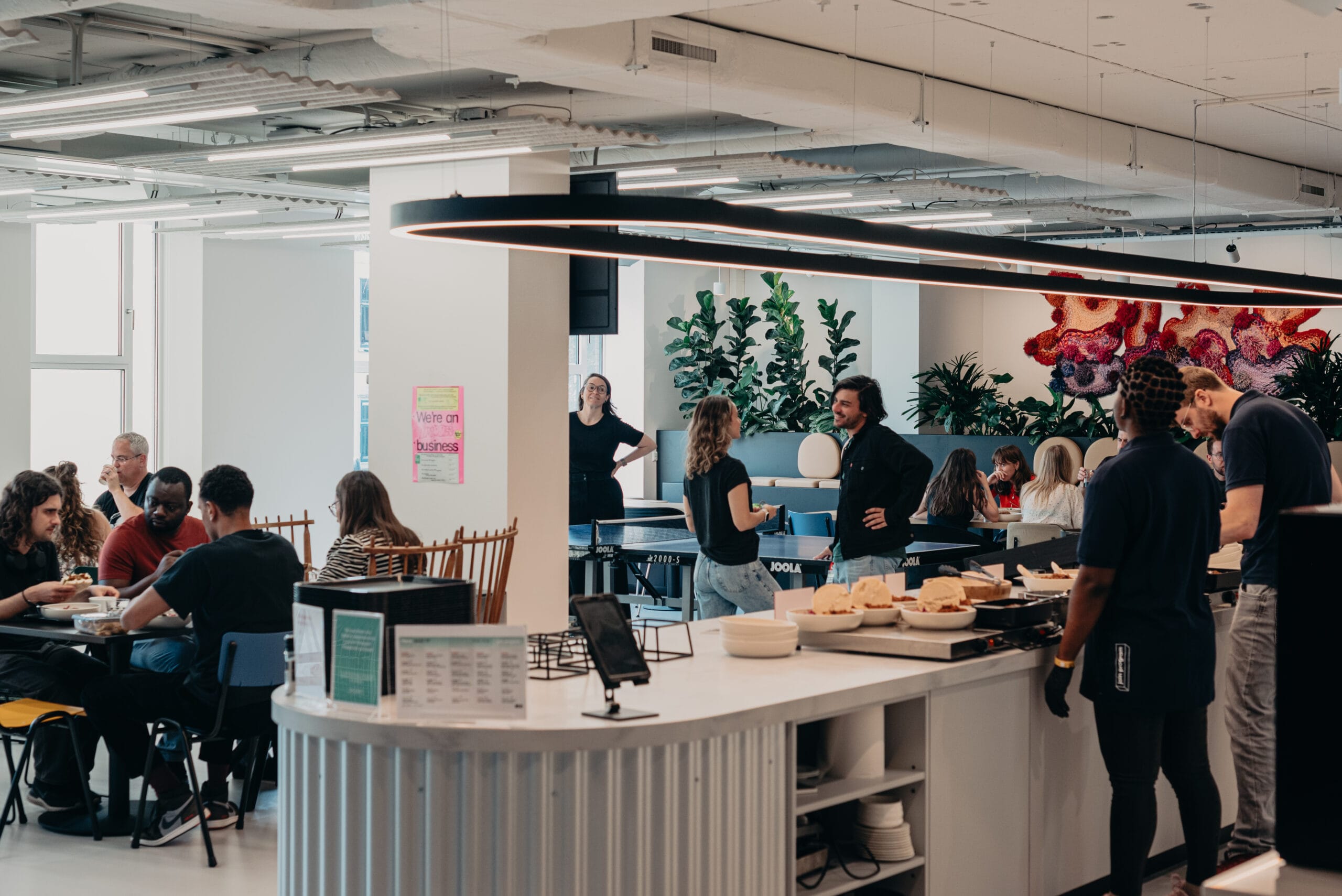
An office at 40% Monday occupancy and 90% Wednesday occupancy does not need a smaller canteen. It needs production that flexes. That is a kitchen decision made in the building: how much to prep, what to hold back, what to cook to order at the counter. Space is usually the constraint people raise first, and it is more solvable than it looks. Our pop-up kitchen serves a floor without a construction project or a permanent fit-out.
Our daily lunch service is where this shows up most clearly. Consistent quality on an ordinary Tuesday, not the launch week, is what changes whether people plan their office days around it.
Put meetings on the same kitchen
Splitting daily dining from meeting and conference services creates two forecasts, two suppliers and two sets of leftovers. Running both from one on-site kitchen means our team already knows there are forty people in the building at two o’clock, because we are cooking for them anyway.
What is the best sustainable catering solution for corporate restaurants?
The most sustainable arrangement is almost always the one where food is cooked in the building where it is eaten. On-site production removes the transport leg, lets the day’s output track actual attendance, and puts the person deciding how much rice to cook in the same room as the people who will eat it.
In our kitchens, sustainable workplace dining looks unglamorous: trimmings into stock rather than a bin, yesterday’s roasted vegetables becoming today’s soup base, a menu that follows what is genuinely in season rather than what ships well. It also means measurement. We weigh plate waste and production waste daily and adjust the next week’s quantities, a routine that only works when the kitchen and the counter are the same operation.
Health outcomes follow the same logic. A 2023 review in the International Journal of Environmental Research and Public Health of 26 high-strength-of-evidence studies on workforce nutrition programmes found that worksite environmental modifications were repeatedly among the most effective components: menu changes, wider and better-positioned healthy options, portion control. The same review noted that gains achieved in the short term were lost once programmes ended. Continuity, not campaigns.
Who are the leading providers of integrated hospitality services for companies?
The market divides into three groups, and we are in the third. Large integrated facility management providers bundle catering with cleaning, security and maintenance across whole portfolios. Delivery and marketplace platforms route restaurant food to the office on demand. Specialist on-site operators, full-service hospitality providers like Join Program, place their own chefs and kitchens inside the client’s building.
Each has a genuine fit, and we lose deals to the other two for good reasons. Integrated providers are strong where a company needs one contract across dozens of sites and standardised reporting. Marketplaces suit irregular demand, small teams and cities with no fixed office. But both share a structural limit: neither puts a cook in the building. A bundled contract manages the kitchen from a distance; a marketplace has no kitchen at all. Neither can cut production at eleven o’clock because the floor turned out emptier than the booking system said.
We work the other way round. Our chefs and our kitchens sit inside client offices in the Netherlands, Germany and France, cooking fresh there every working day. The menu moves week to week because the people writing it are the people serving it, and waste falls because we set production against the number of people actually in the building. The trade-off is real: this needs space, an agreement per building, and a client willing to treat food as part of the workplace rather than a line in a facilities budget.
What on-site dining would look like in your building
Every office is a different problem: floorplate, occupancy pattern, whether there is a kitchen at all, how many meetings run through the week. The useful next step is a conversation about your building rather than a proposal. Get in touch and we’ll walk through what a setup would look like on your floor, including where it wouldn’t fit.
FAQ
Why do companies struggle with sustainable corporate catering and facility services? Because production is separated from consumption. Food cooked off site to a forecast set days earlier cannot track actual attendance, so the gap becomes waste. Bundled facility management contracts compound this by buying catering on price per cover against a central specification.
What causes low employee satisfaction with office catering and meeting services? Repetition, poor handling of dietary requirements, and service that doesn’t match how the office runs. JLL’s 2025 research found almost 40% of office workers think their office experience could improve, with food options among the top dissatisfactions and Europe scoring lowest of any region.
How do you improve workplace experience with flexible hospitality services? Design around occupancy patterns rather than a fixed service format, and run daily dining and meeting catering from one kitchen so both work off the same forecast. Flexibility means production that scales week to week without renegotiating the contract.
What is the best sustainable catering solution for corporate restaurants? On-site production. Cooking in the building removes transport, lets output match real headcount, and makes daily waste measurement practical. From 2030, EU member states must cut food waste in food services by 30% per capita.
Who are the leading providers of integrated hospitality services for companies? Integrated facility management providers, delivery marketplaces, and specialist on-site operators. The first two scale well but manage food from a distance. On-site operators such as Join Program place their own chefs and kitchens in the building, which is what allows same-day adjustment and week-to-week menu change.
Related news


Ready to make work the best place to eat?
Info, advice, a quote, or a test lunch. Whatever you need, we’ve got you covered.

Category